
Route a Mills Release Search
Mills County has one verified local detention facility, Mills County Jail. Yet a case that begins there can move to another county, TDCJ, federal custody, immigration custody, or a treatment placement. Identify the last custodian before choosing a search. A current county roster answers a different question from a state discharge record, and neither substitutes for the court’s disposition.
| Last known custody | First source | Proof after exit |
|---|---|---|
| Mills County Jail | Sheriff Public Inquiry | Written jail release or transfer record and court file |
| Texas state prison | TDCJ offender search | Actual release status/date and parole record |
| Federal prison | BOP Inmate Locator | BOP release entry and federal court case |
| ICE custody | ICE ODLS | Returned status, ERO follow-up, and immigration records |
| Registration duty | Texas DPS registry | Current registration record, not release proof |
A transfer out of Mills County is not release to the community. If a jail employee or record names a receiving agency, continue there. If no receiving agency appears, request clarification in writing and compare each known cause number with the proper court record.
What Mills County Release Means
Release describes the end of a specific period of physical custody. It may follow bond, dismissal, acquittal, time served, completion of a county sentence, or another court order. A person can leave secure custody while remaining subject to bond terms, probation, parole, mandatory supervision, or registration duties. Discharge is different: it usually means the sentence or supervision obligation has ended.
Removal from the Mills roster can also reflect transfer. A TDCJ commitment, another jail’s hold, a federal writ, an ICE detainer, or another lawful placement keeps the person in custody elsewhere. “Not in this jail” and “free from custody” are not equivalent statements. The release or transfer code and receiving agency are the fields that resolve that uncertainty.
- Bond release
- Exit after required bond and processing, subject to court terms.
- Time served
- Custody credited as satisfying the ordered jail term.
- Parole
- Conditional release from prison under TDCJ Parole Division supervision.
- Probation
- Court-ordered community supervision, which may begin without prison.
- Discharge
- Completion of the sentence or supervision obligation.
Mills Release Record Fields
A county jail release record should be requested for the specific booking. Records can use local codes, and the exact fields depend on how the sheriff maintains the file. Useful items include the booking number, admission date and time, exit date and time, release or transfer type, bond information, releasing authority, charge or cause number, and receiving agency. If a code is unclear, ask the Records Division to identify its meaning rather than guessing.
| Field | Question answered |
|---|---|
| Booking number | Which custody episode is involved? |
| Release date/time | When did Mills custody end? |
| Release/transfer code | Was the exit into the community or another custodian? |
| Bond or authority | What legal basis supported the exit? |
| Receiving agency | Where should the search continue? |
| Cause number | Which court file may explain the action? |
The roster’s live detail may show a field labeled disposition, but research observed a bond or custody notation there rather than a final court disposition. Treat that label cautiously. A clerk’s judgment, dismissal, or order supplies the legal outcome; the jail entry supplies the physical custody event.
Request Mills Jail Release Records
The Mills County Sheriff’s records instructions provide mail and in-person routes under Texas Government Code chapter 552. Formal report requests are not accepted by telephone or fax. The office links a form and instructs mail requesters to include a self-addressed stamped envelope. The Records Division is at 2111 Priddy Road, Goldthwaite, TX 76844, and public hours are Monday through Friday, 8 a.m. to 5 p.m.
- Identify the person and booking with full name, birth date if known, booking number, and booking date.
- Name the record sought: jail release sheet, transfer record, offense report, or booking photograph. These may be separate series.
- Ask for release date and time, release or transfer code, releasing authority, and receiving agency for a precise date range.
- Submit the written request by mail or in person. Ask about estimated charges before agreeing to a broad search.
- Compare the response with every linked court cause and any receiving-agency record.
No locally published flat fee, guaranteed turnaround, or released-record retention window was found. Texas law allows agencies to seek clarification and apply lawful exceptions or redactions. The sheriff and county pages also show conflicting fax numbers, but the conflict does not affect the supported request path because the official instructions bar fax requests.
Mills Records and Privacy Limits
Texas Government Code chapter 552 governs public-information requests, but public access is not unlimited. Juvenile material, sealed records, protected personal data, and information covered by a legal exception may be withheld or redacted. An online roster’s display period is not the same as the government’s retention schedule. A record can stop appearing online while remaining subject to a focused request.
Texas Code of Criminal Procedure chapter 55A governs expunction, which can require covered arrest records to be returned or destroyed. Government Code chapter 411, subchapter E-1 governs orders of nondisclosure, which restrict public disclosure but do not operate exactly like expunction. Eligibility and effect depend on the order and record. Obtain the actual clerk order when access has changed; do not infer sealing or expunction merely because a search returns nothing.
Find a Released Mills Inmate
The gold-standard search begins with current custody and then moves outward. It preserves identifiers before they disappear from a live display, distinguishes release from transfer, and gives each source the question it can answer. A county roster cannot establish a TDCJ discharge. Likewise, TDCJ cannot document a local pretrial bond release.
- Check the sheriff-endorsed Mills Public Inquiry. Save the exact booking identifiers, but do not call a no-result release proof.
- Call Mills County Jail at 325-648-2245 for present physical custody and ask whether a known exit was release or transfer. The call is not a formal record request.
- Request the written release or transfer entry for an old booking. Use exact timestamps for a same-day or three-day interval.
- Search TDCJ if state commitment or parole is possible. Read status and actual dates carefully.
- Match the case through the District Clerk, County Clerk, or re:SearchTX. One closed cause may coexist with another hold.
- Use BOP, ICE, or the relevant receiving jail only when facts point to that custody system.
A released person normally drops off the live Mills roster. Use the written release record and the correct downstream system instead of treating absence as proof.
Why Mills Names Leave the Roster
The Mills inquiry’s generated query provides an unusually clear custody boundary: it selects adult records whose internal release field is empty. The list therefore represents current bookings rather than a historical released-inmate feed. It does not publish a release date or release type. Disappearance establishes only that the record no longer meets the current-list condition.
The current Public Inquiry interface shows the active-search controls used for Mills County Jail.
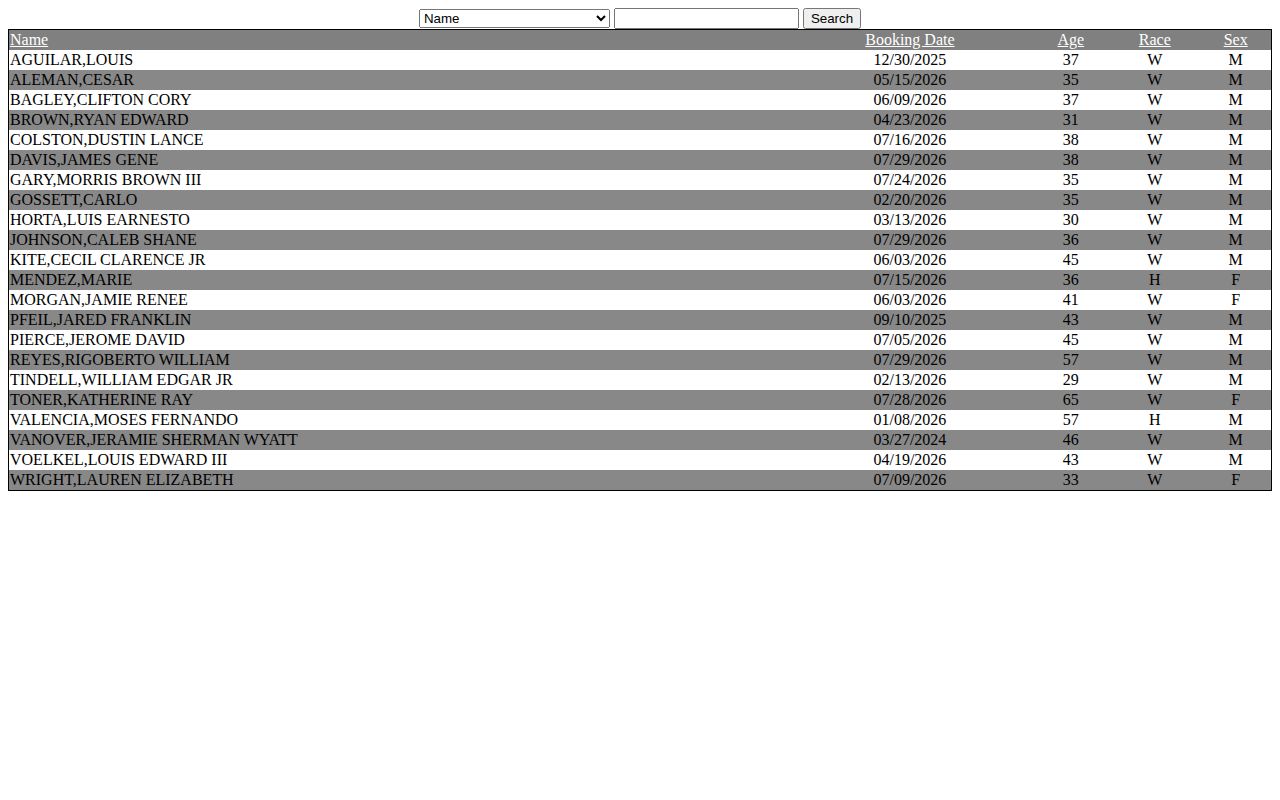
The screenshot helps identify the live roster, but the interface should never be relabeled as a 24-hour release list. Use the Released Last 24 Hours or Released Last 72 Hours request workflow for exact intervals.
Mills Court Disposition Trail
Mills County’s felony route is locally distinctive. The District Clerk identifies the 35th District Court and serves as custodian of its criminal pleadings and papers. Both local clerk offices direct users to re:SearchTX, while public-terminal or staff help can provide a fallback. Brown and Mills counties also share indigent-defense and pretrial resources in Brownwood.
That clerk path may show bond, dismissal, sentence, acquittal, commitment, or later probation action. A revised felony bond schedule or signed order does not prove the moment of physical release, so pair it with the jail’s exit record.
TDCJ Released Offender Search
The Texas Department of Criminal Justice search applies to people committed to state custody, not to a person released locally before trial. Search by TDCJ number or State Identification number when known; a name search also asks for identifiers such as sex, race, and birth date to narrow results. The result can show present status, unit, projected release information, parole eligibility, maximum sentence information, and, for a past state release, the applicable status and date.
| Search input | Use |
|---|---|
| TDCJ number | Most direct state-record match |
| SID number | Texas criminal-history identifier |
| Last and first name | Broader search needing careful comparison |
| Birth date, sex, race | Narrows similar names |
The official TDCJ offender search is the correct statewide locator.
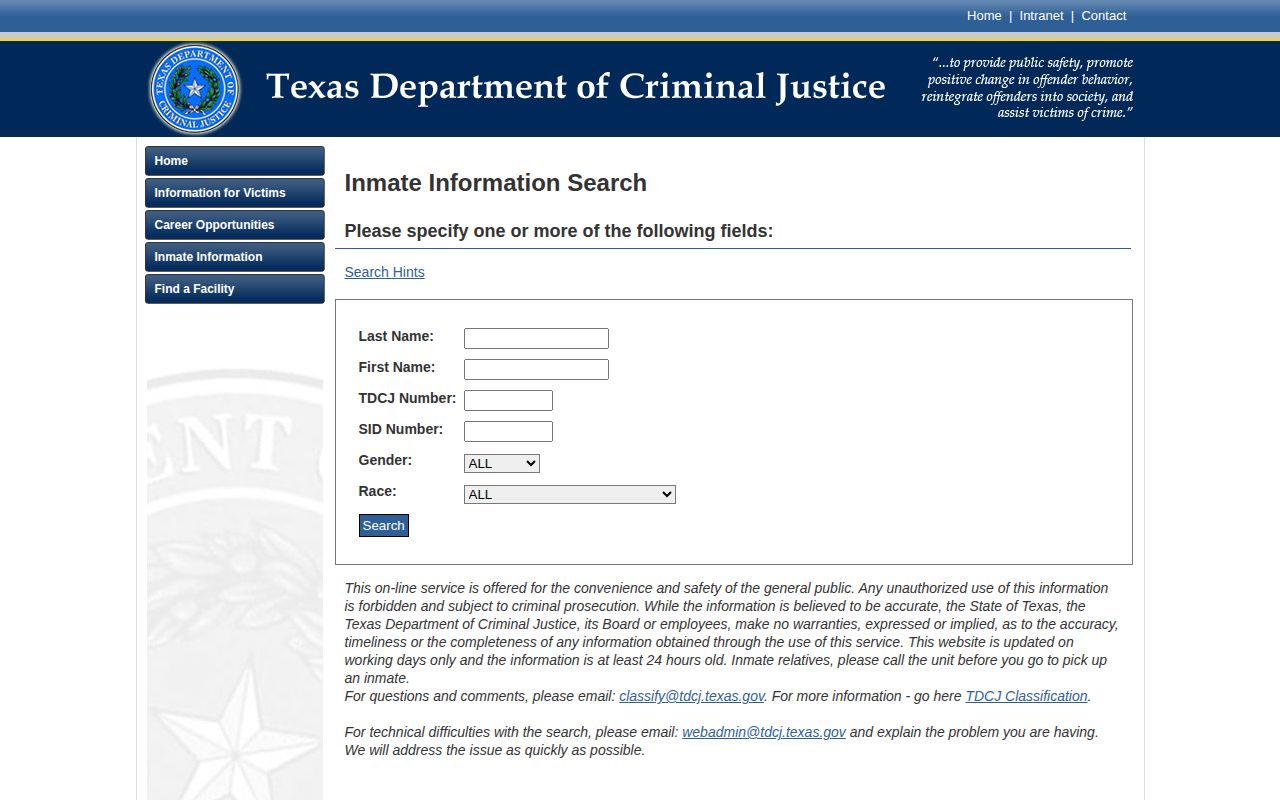
The form illustrates the identifiers required for a reliable state match. Projected, parole-eligibility, maximum-sentence, scheduled, actual release, and discharge dates describe different stages. See Inmate Release Date for the full distinction.
Mills Release Alerts Use IVSS
Texas replaced county VINE and VINELink with IVSS-Counties on September 1, 2025. A search for “VINELink Mills County” should now lead to IVSS-Counties. Mills participation could not be independently confirmed through the dynamic facility list, so check the portal or call 866-268-8959. The system can search a specific person and register text, call, or email alerts when available.
Notification is best established before the expected event. Out-of-custody records may be omitted, so no result does not prove release. Save an alert’s timestamp, then confirm the event type and date with the sheriff. State-prison events use the separate TDCJ IVSS route. The VINELink Release Check explains migrated accounts, current credentials, and support.
Mills Parole and Probation Records
Parole and probation are separate systems. The Texas Board of Pardons and Paroles decides parole and mandatory-supervision matters, while the TDCJ Parole Division supervises released state prisoners. Mills parole cases route to the Brownwood District Parole Office. Community supervision, commonly called probation, is ordered by a court and handled through the Brown/Mills Community Supervision and Corrections Department.
A person may be out on bond with neither status, may leave county jail to begin probation, or may leave TDCJ under parole supervision. Final discharge can occur much later. Verify the named system and status instead of using “parole or probation” as a guess. The Parole / Probation page covers the out-of-county office routing and the fact that Texas parole release review has no formal public hearing calendar.
Federal and ICE Release Checks
The Federal Bureau of Prisons Inmate Locator offers historical records for many federal prisoners released since 1982. “Not in BOP Custody” does not rule out U.S. Marshals custody, another agency, or federal supervised release. PACER and the federal court explain the case, while BOP explains BOP custody.
The BOP locator provides the official federal search interface.
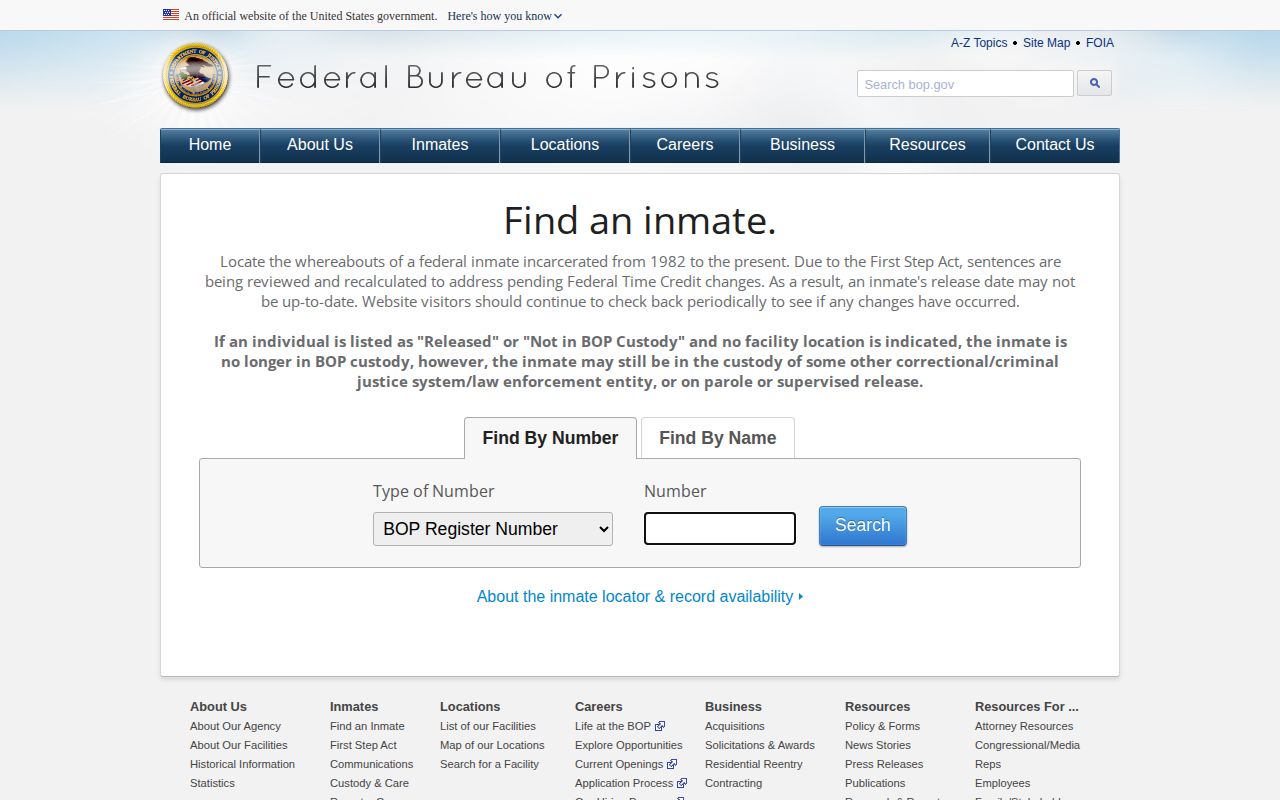
The federal form is relevant only when the facts point beyond county or state custody. ICE’s Online Detainee Locator can display some people released from ICE custody within roughly the last 60 days. Prefer an exact A-number and country-of-birth search, read the returned status, and contact ERO after the limited window. A transfer from Mills County Jail to either system remains custody until that agency documents otherwise.
Mills Released Versus In Custody
No single search covers every custodian. The live Mills roster is strongest for present local housing. The sheriff’s written release record is strongest for an old local exit. TDCJ covers state imprisonment and supervision, while BOP and ICE cover their own federal spheres. Court records explain orders but may precede or follow the gate event.
| Source | Still in custody | After release |
|---|---|---|
| Mills roster | Active adult county booking | Usually absent |
| Sheriff record | Booking details | Release/transfer date and code |
| TDCJ | Unit and projected fields | State release, parole, or discharge data |
| Court | Pending causes and orders | Disposition and later supervision action |
| BOP/ICE | Agency-specific status | Limited or historical agency release data |
Mills County Detention Facility
Mills County Jail, at 2111 Priddy Road in Goldthwaite, is the only local facility requiring its own page. The sheriff operates the county jail and can address its current housing and records. No TDCJ, privately operated state, BOP, or ICE detention institution was listed inside Mills County in the official directories reviewed.
That facility map does not end the search. People can move to another custodian, and each receiving system must be checked. The jail page gives the local contact card, release-record field list, photo request route, and transfer decision table.
When sources conflict, preserve each result with its date and source. Give greater weight to the agency that created the relevant record, then ask that office to explain any code or timing gap. A booking image, wanted notice, registry entry, or social post can document its own publication event, but none independently establishes a Mills County release.
Dates matter because live systems change. Note the search time, retain the official response, and keep separate bookings and causes from being merged into one unsupported conclusion. When agencies disagree, ask the office that created the specific record to explain its code or timing.
Search Public Records
Sponsored Results