
Mills Projected and Actual Release
TDCJ defines a projected release date as the date Classification and Records estimates a person will leave incarceration unless paroled sooner. The estimate uses the sentence, offense date, legal eligibility, time served, credits, and release mechanism. It concerns a state prisoner, not a simple Mills County Jail bond-out.
A scheduled date follows later release processing. Actual release is the physical exit or transfer to supervision. Discharge is later and marks completion of the sentence obligation. Parole eligibility only identifies when review may become possible.
A pretrial Mills detainee has no sentence endpoint. Bond, dismissal, plea, or another order may authorize a change, but authorization can precede physical release.
Find a Mills Inmate Release Date
Use the system that controls the sentence. TDCJ covers Texas prison records, while the sheriff and sentencing court hold the county-jail path. The Mills County release-record search helps establish the custody trail.
- Identify the custodian. A Mills Public Inquiry result points to county custody; a TDCJ record points to state corrections.
- Open the TDCJ Inmate Information Search. A TDCJ or SID number gives the strongest match.
- Compare age, offense, conviction county, and sentence data. Do not accept a common-name match alone.
- Read Projected Release Date, Parole Eligibility Date, and Maximum Sentence Date as separate fields.
- For a Mills jail sentence, obtain the judgment and jail sentence-credit calculation.
- Verify an impending state release with TDCJ and a county exit with the jail record.
The official TDCJ search screen shows the state lookup fields.
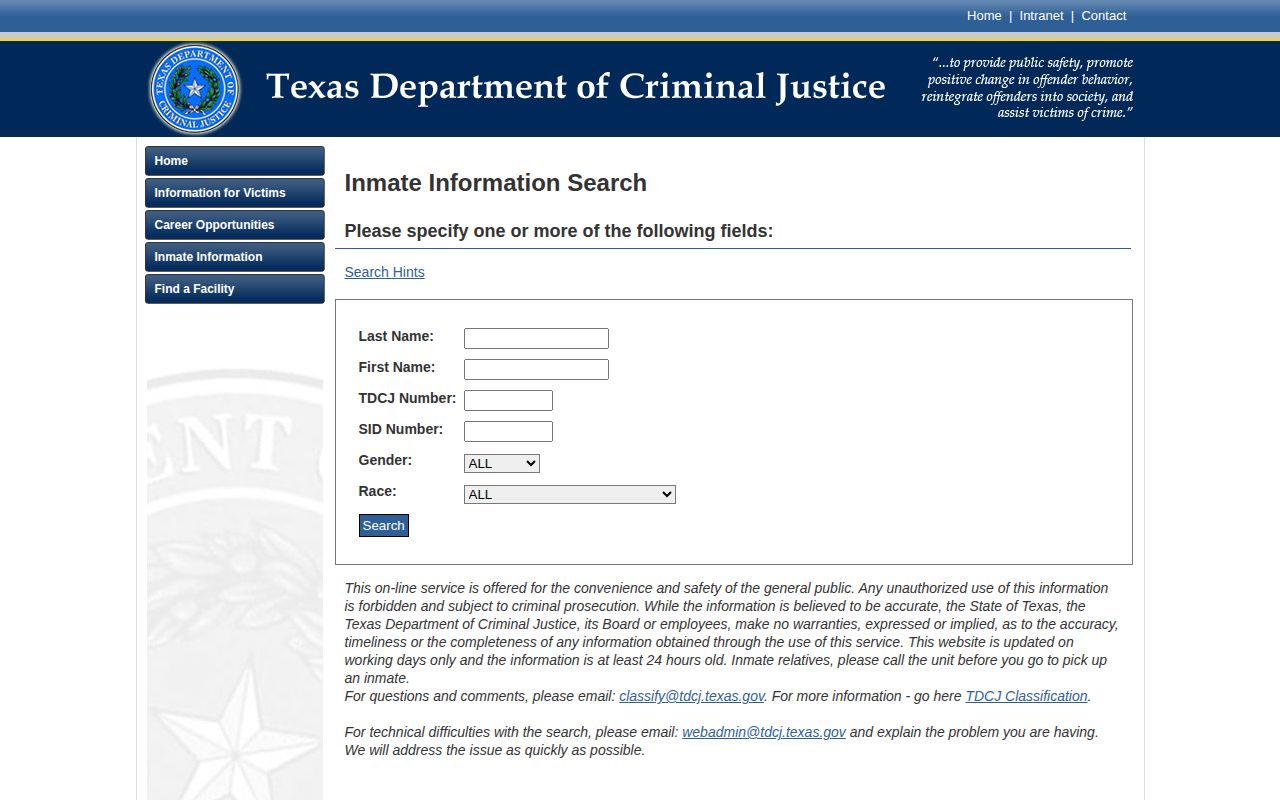
This state search cannot prove a local Mills bond release. A roster disappearance followed by a TDCJ result usually means transfer or commitment.
Texas Credits Shape Mills Release Dates
Texas Government Code chapter 498 governs good-conduct time. Section 498.003 permits accrual based on classification; §498.004 permits forfeiture or suspension; §498.005 calls credit a privilege used for parole or mandatory-supervision eligibility, not a reduction of the sentence itself.
Texas has no general 85-percent rule. Under §508.145(f), a general parole formula uses actual time plus good time equal to one-fourth of the sentence or 15 years, whichever is less. For article 42A.054 and selected serious or deadly-weapon cases, §508.145(d) generally requires calendar time equal to one-half of the sentence or 30 years, whichever is less, with at least two years. Other offenses have special rules.
Eligibility never guarantees approval. The offense-date version matters because amendments may alter a calculation.
Note: Good time can move a Mills release projection, but it does not prove that release occurred.
Why Mills Release Dates Move
A displayed date reflects facts known at that point. Later decisions can move it or replace it with another milestone.
| Factor | Effect | Confirmation |
|---|---|---|
| Good-time accrual | May advance an eligible projection | TDCJ calculation |
| Credit loss | May delay projection | Updated TDCJ record |
| Mandatory-supervision denial | Can move date to maximum expiration | BPP result |
| Later approval | Can move date earlier | BPP and TDCJ |
| Detainer | Can block release or cause transfer | Holding agencies |
| Court order | Can alter credit or authority | Filed order |
| Program or residence review | Can delay release after approval | Release Processing |
The court controls its order, TDCJ controls the state calculation, and Mills County Jail controls the local physical exit. Match each question to its custodian.
Confirm a Mills Release Event
A favorable parole vote is not physical release. TDCJ reports that audit after approval often takes about 14 to 21 business days. A required program may take roughly four to six weeks plus residence approval. Dates can change without notice. Review and Release Processing at 512-406-5202 handles post-approval status.
For county custody, call Mills County Jail at 325-648-2245 about present housing and whether an exit was release or transfer. Written records give durable proof. The sheriff does not accept formal report requests by telephone or fax.
Texas IVSS-Counties can send a county event notice if Mills participates. TDCJ runs a separate IVSS. The Mills VINELink release check explains that split. Preserve an alert, then verify it with the custodian.
Mills Mandatory Supervision Date Changes
Texas discretionary mandatory supervision creates a distinctive shift. For eligible later cases, BPP must approve release. A denial can cause projected release to become maximum expiration. Later approval can move it earlier. The field changes because the legal path changed, not necessarily because data was wrong.
For eligible pre-September 1996 cases, flat time plus good time may equal the sentence. Someone ineligible for mandatory supervision generally has a projection at maximum expiration. Government Code §§508.147 through 508.149 govern the boundaries.
Preserve the label, lookup date, and status. Compare the current result with the TDCJ definitions before relying on it.
Mills County Jail Sentence Dates
TDCJ formulas do not calculate a county-jail sentence. The judgment, lawful credit, sheriff's calculation, other holds, and court orders govern. Texas state-jail diligent-participation credit is a narrow exception: for qualifying offenses, the judge may award up to 20 percent.
Ask the Mills clerk for the judgment and later orders using the cause number. Ask jail records for the sentence-credit and release event tied to that booking. Each custodian should reconcile its own fact.
Pretrial status is different. Bond set or dismissal entered may authorize change, but processing and other holds can delay departure. Only the jail record confirms when and how the person left.
Mills Release Date Labels Compared
TDCJ date labels form a sequence, not a set of synonyms. The projected release date is an administrative estimate under the person's present calculation. Parole eligibility marks a point at which review may be available. Maximum sentence date is the sentence endpoint under the authoritative calculation. A BPP vote records a panel decision, while a scheduled date means release processing has progressed far enough for a planned event.
Actual parole or mandatory-supervision release means the person left incarceration for supervision. Discharge comes when the sentence obligation ends. Someone can therefore be released yet not discharged. Conversely, a person can reach an eligibility date and remain incarcerated after denial. Writing down the complete field label with the date prevents these common errors.
- Flat time
- Calendar time actually served.
- Good time
- Classification-based credit used in eligible release calculations.
- Detainer
- A request or legal hold from another authority that can cause continued custody or transfer.
- Maximum expiration
- The calculated sentence endpoint, subject to authoritative corrections and orders.
Mills State Release Processing Stages
After a favorable BPP result, TDCJ still checks the release certificate, sentence calculation, disciplinary record, required programs, residence plan, and other legal holds. A favorable FI vote can include a program, condition, or future date. It may also be reconsidered when new information arrives. None of those entries means the person has already left.
Before a vote, BPP status at 844-512-0461 can explain the review stage. After approval, Review and Release Processing at 512-406-5202 is the better channel. Ask whether the case is still in audit, awaiting a program, pending residence approval, scheduled, or physically released. Those precise terms are more useful than asking only for the release date.
A receiving agency matters too. A detainer can turn the expected community release into a transfer. The TDCJ record controls the departure from state prison, while the receiving agency controls the next custody status. A later Mills court record may explain a local case but cannot establish the state gate time.
Resolve Mills Release Date Conflicts
Search results can differ because they answer different questions or refresh at different times. Save the search date, exact label, status, unit, and identifiers. Then compare the filed judgment, TDCJ record, BPP result, and any IVSS notice without treating one as a substitute for another.
If the Mills roster no longer shows the person, say only that the current roster does not return the booking until the jail identifies release or transfer. If TDCJ then shows a unit, the stronger explanation is state commitment. If neither system returns a clear record, submit a focused sheriff request for the booking number, release or transfer date and time, release type, and receiving authority where public.
Telephone information is useful for immediate planning but can be limited and transient. Note who supplied the answer and when. Follow with the written record when exact proof is needed for a court or records purpose.
The Mills District Clerk is the custodian for criminal papers in the 35th District Court and links re:SearchTX. Court records can explain the sentence or later order, but they do not timestamp the physical gate event. Match the cause number to the booking before combining the court and jail timelines.